Key Features
Simulations: Powerful, Adaptive, and Insightful
Elevate your electromagnetic simulation to unprecedented heights with an advanced 3D Ray Tracer, engineered to meet the most demanding research needs with exceptional precision and performance. Built on cutting-edge raytracing algorithms and high-performance computational methods, it models and investigates structurally complex propagation environments (up to 1.1 THz), material interactions, and system behaviours, delivering rapid feedback on design changes, perfect for randomized and dynamic environments.
- Adjustable parameters for transmitter frequency, input power, antenna types, and material properties in the propagation environment.
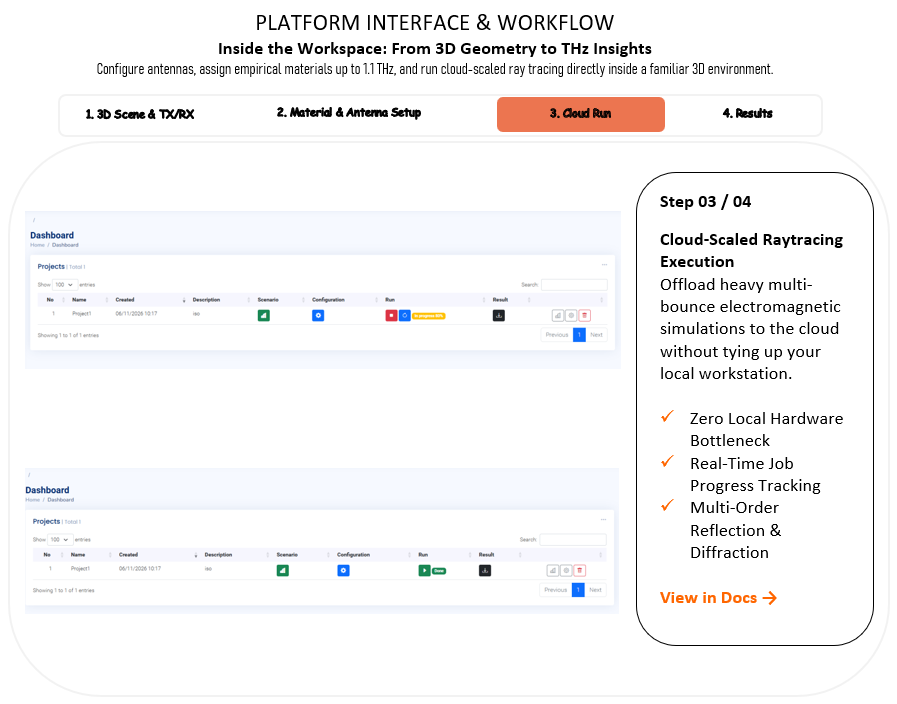
- Real-time simulation status monitoring and performance insights streamline your workflow.
- Automated result post-processing simplifies reporting and enables direct comparison.
3D Scenario: Visualize, Experiment, Mobility, and Perfect
Transform theoretical models into immersive 3D scenarios with film-like visuals and scientific mobility. Build, edit, and analyze real-world electromagnetic propagation contexts, including urban structures, custom devices, and biological materials, using intuitive drag-and-drop tools and a responsive, dynamic viewport.
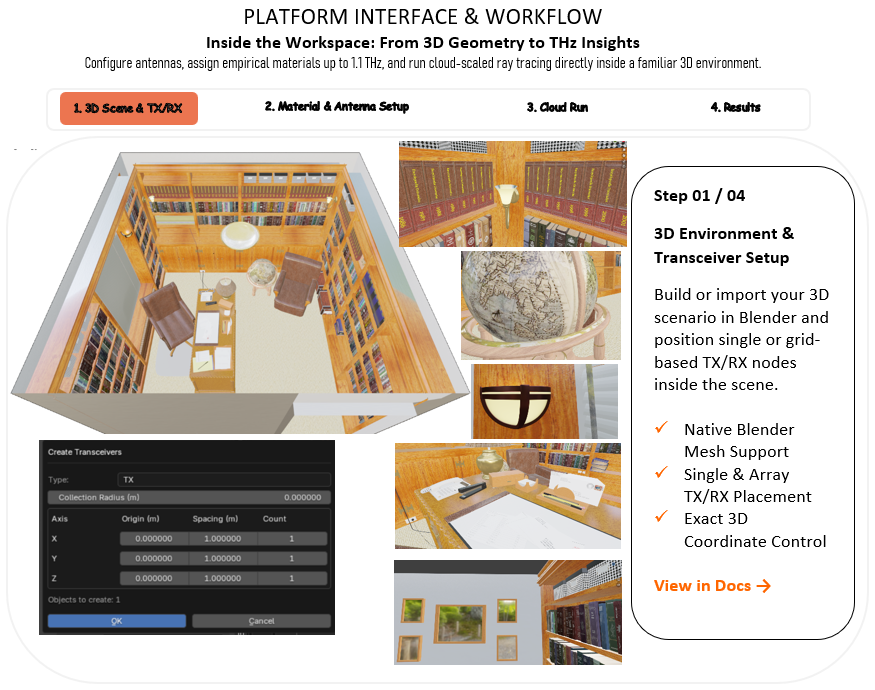
- Edit scenarios interactively in 3D using community-driven tools like Bforartists, MakeHuman, and Blender: place transmitters, objects, and receivers with precise controls.
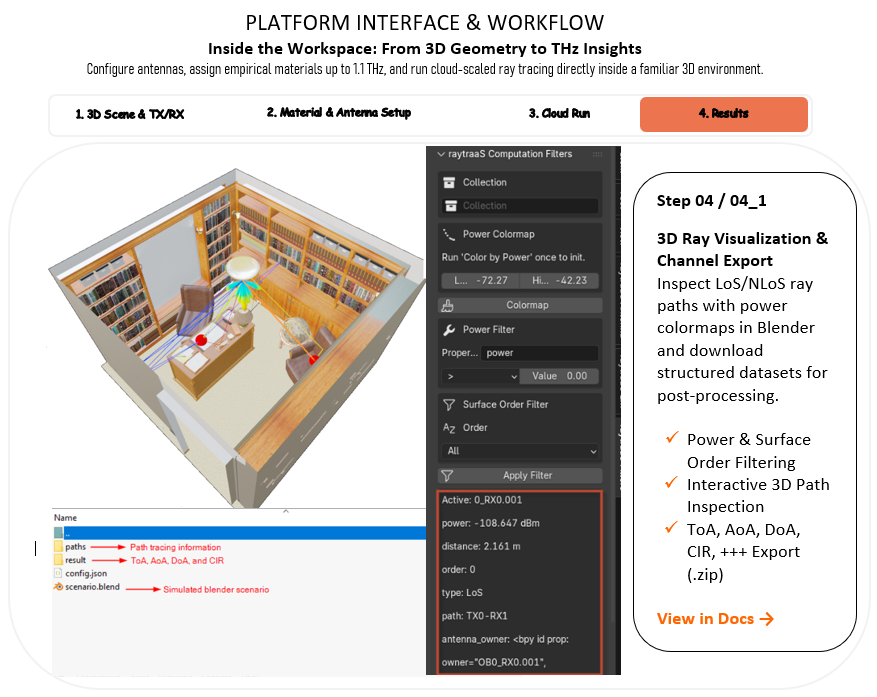
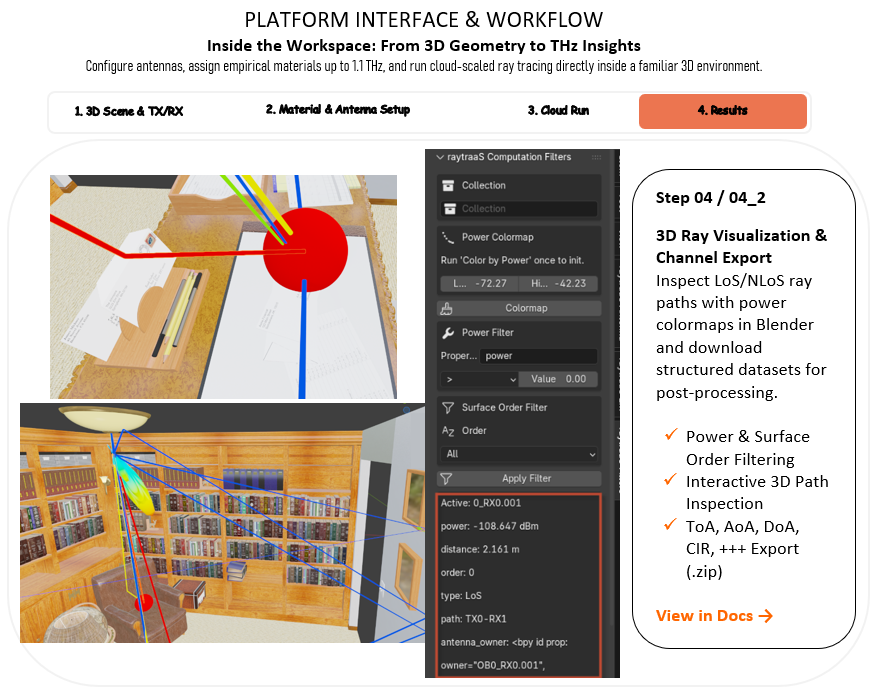
- Immediate visual feedback on ray tracing, field strength, and propagation paths.
- Scenario library: begin with ready-made templates or design new scenes from scratch, and export high-resolution scientific images and detailed animations for presentations or further analysis tasks.
User Interfaces
FAQs
raytraaS combines advanced electromagnetic propagation simulation, high-fidelity 3D digital twins, and cloud-based raytracing into a single integrated workflow across GHz and THz frequencies. It enables researchers and engineers to analyze radio-wave propagation, evaluate wireless coverage, and explore dynamic scenarios involving moving vehicles, drones, and pedestrians. Through Twin as a Service (TaaS) and Simulation as a Service (SIMaaS), customers can also access custom 3D digital twins and expert-managed simulations without managing complex technical setups in-house.
raytraaS supports a wide range of industries and academic research fields that rely on electromagnetic modeling and simulation. These include telecommunications and wireless communications (covering 2.4 GHz and 5 GHz Wi-Fi, sub-6 GHz, ultra-wideband (UWB), 60 GHz, millimeter-wave (mmWave), sub-terahertz (sub-THz), and emerging 6G research), automotive radar and sensing, aerospace and defense, industrial automation, healthcare and medical technology, and consumer electronics. Its capabilities in electromagnetic raytracing, radio-wave propagation, channel modeling, radar, sensing, localization, and digital twin modeling enable researchers and engineers to investigate complex electromagnetic environments, evaluate system performance, and explore emerging technologies across GHz and THz frequency ranges.
We offer a free live demonstration led by an engineer to help you explore raytraaS and see how it fits your specific simulation needs. Interested in a free demo? Contact our team.
Yes. We offer hands-on training programs and technical workshops tailored for researchers, engineers, and network architects working with raytracing and EM digital twin (EMTwins) modeling. For technical support, email us at support@raytraas.com. Our team responds within 24 hours on business days.
You don't need to purchase a full annual license. Through our Simulation as a Service (SIMaaS) and Twin as a Service (TaaS) offerings, our expert team can handle individual simulation tasks or construct custom 3D digital twins on a single-project basis. Simply provide your requirements, and we will deliver tailored results without any ongoing license commitment.
raytraaS features real-time progress tracking dashboards showing current raytracing status live during simulation execution to streamline your workflow.
raytraaS automates the post-processing and visualization of key electromagnetic metrics, including path loss, delay spread, power profiles, angular spreads, and complex impulse responses. Processed results can be directly exported to enable scenario comparisons, streamline report generation, and facilitate data sharing for collaborative research and informed decision-making. The resulting visualizations are also well suited for technical documentation, peer-reviewed publications, and client presentations.
By offloading computationally intensive electromagnetic simulations to our cloud computing infrastructure, hosted on servers in the European Union, raytraaS enables the parallel execution of complex scenarios, reducing computation time while ensuring strict adherence to European data privacy standards.
raytraaS provides intuitive 3D scene editing through seamless integration with popular tools like Blender, Bforartists, and MakeHuman. You can build custom propagation environments from scratch or choose from our template library, placing transmitters, receivers, and objects with precise coordinate controls.
Not necessarily. If you opt for Twin as a Service (TaaS), our specialists design and build your 3D digital twins for you including dielectric material properties (i.e., EMTwins), requiring no local modeling software. However, if you prefer to create and customize your own 3D scenes, you will need to install Blender 4.5 or later and the supporting workflow libraries. All standard licenses include a step-by-step setup guide to assist with installation.
Yes. Transmitters, receivers, transceivers, and physical obstacles can be programmed along dynamic motion paths to simulate time-varying scenarios involving flying drones (UAVs), moving vehicles, pedestrians, or foliage. Atmospheric parameters such as ambient temperature, barometric pressure, and relative humidity can also be integrated into the propagation context.
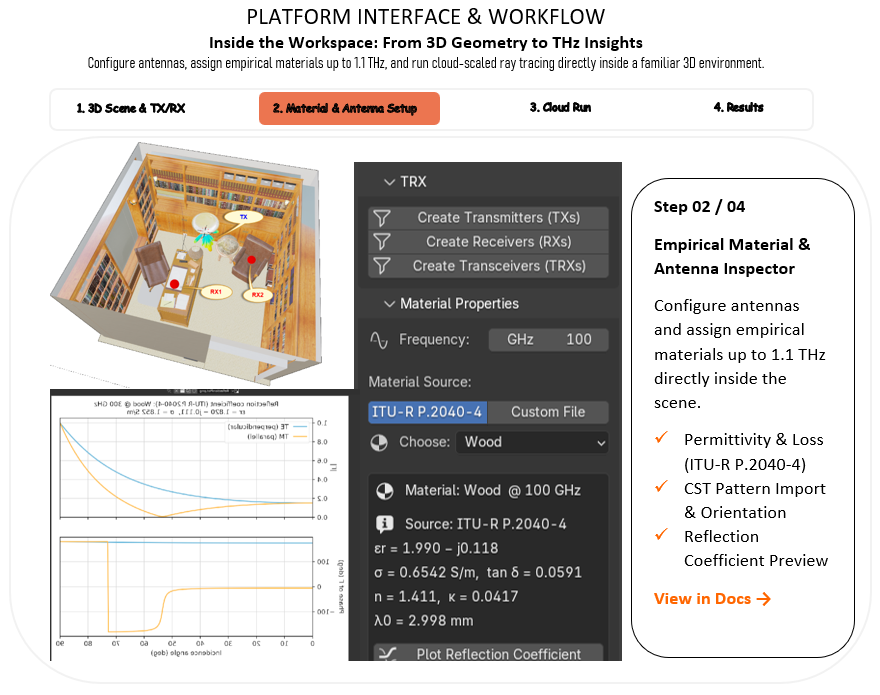
raytraaS supports electromagnetic propagation simulations from the GHz range up to 1.1 THz, serving as an accessible and cost-effective entry point for sub-THz and THz research. The platform incorporates key physical propagation effects, including atmospheric attenuation, surface roughness modeling, frequency-dependent material group absorption, and far-field raytracing analysis. Future updates will extend frequency coverage up to 3 THz.
raytraaS utilizes advanced forward raytracing engines optimized for high-frequency electromagnetic propagation. The engine accurately models key wave-matter interactions required for sub-THz and THz analysis, including:
- Specular Reflection & Transmission (or penetration)
- Diffraction
- Diffuse Scattering (i.e., non-specular reflections)
- Atmospheric Attenuation Effects
Choose Your Plan
Free
- 5MB Files Upload i Maximum file size limit for importing custom 3D scenarios or CAD geometries.
- Limited Configurations i Access to standard transmitter frequencies, default material properties, and single-run simulations.
Academic
- 4 Cores CPU
- 8GB RAM
- 240GB Storage
- Multi-User Access i Allows multiple team members or students to access and use raytraaS under a shared institutional license, enabling collaboration within the same account.
- Unlimited Projects i Create, save, and manage as many unique propagation scenarios as your workflow requires.
- Parallel Simulations i Run multiple ray tracing jobs simultaneously to compare different antenna setups or frequencies.
Enterprise
- 32 Cores CPU
- 64GB RAM
- 2TB Storage
- Multi-User Access i Allows multiple team members or students to access and use raytraaS under a shared institutional license, enabling collaboration within the same account.
- Unlimited Projects i Create, save, and manage as many unique propagation scenarios as your workflow requires.
- Parallel Simulations i Run multiple ray tracing jobs simultaneously to compare different antenna setups or frequencies.
Don't See a Plan That Fits Your Needs?
Need more computing power, specialized resources, or a customized plan?
Tell us about your simulation requirements, and we'll work with you to find a suitable solution.
Contact Us for a Custom Solution
Twin as a Service (TaaS)
Your Lab. Your Layout. Our Engineering.
We create Your High-Fidelity 3D Digital Twins with Electromagnetic Material Properties (EMTwins) up to 1.1 THz.
Transform your laboratory into an interactive 3D experience with our Digital Twin Modeling Service. Simply provide details of your laboratory or scenario, together with photographs and accurate dimensions, and we will create a high-resolution digital twin that faithfully represents your environment. Combined with our Simulation as a Service (SIMaaS) offering, your digital twin can support compelling proposals for academic and industrial research projects by bringing together cinematic-quality visuals, dynamic scenarios, and mobility-aware electromagnetic channel simulations. This integrated approach helps you communicate research concepts, demonstrate proposed applications, and engage potential collaborators and funding partners with greater impact.
Simulation as a Service (SIMaaS)
You Define. We Simulate. You Discover.
Expert-Driven Simulation as a Service, Powered by raytraaS.
Whether you are investigating reconfigurable intelligent surface (RIS)-assisted channels, radar propagation, or wireless links from GHz frequencies up to 1.1 THz, our expert-led Simulation as a Service (SIMaaS) offering delivers electromagnetic simulations tailored to your research and engineering needs. Simply provide your scenario, objectives, and available input data—our specialists handle simulation setup, execution, post-processing, and interpretation of the results. Using your digital twin or a purpose-built 3D model, our team configures user-defined antennas, transmitter and receiver positions, frequency-dependent material properties, and object trajectories. If you also need a digital twin of your laboratory, device, or propagation environment, please visit our Twin as a Service (TaaS) section to learn how we can create one for you. Together, these services enable the investigation of static and time-varying environments, supported by cinematic-quality visualizations and animations that clearly communicate your scenario and simulation results.
info@raytraas.com
About Us
Pioneering...
From GHz to THz: Connecting Electromagnetic Research, Measurements, Simulation, and EMTwins
RF/THz Measurements · Inertial Measurement Units (IMUs) · Raytracing · Radar · RFID · Sensing · Localization · Propagation · Channel Modeling · THz Imaging · Massive MIMO · Material Characterization · UAV · Mobility
We pioneer research and engineering across the electromagnetic spectrum, from GHz to THz, connecting RF/THz measurements, material characterization, simulation, and digital twins. Our expertise spans raytracing, electromagnetic propagation and channel modeling, radar, RFID, sensing, localization, THz imaging, and massive MIMO, alongside mobility-aware applications involving inertial measurement units (IMUs) and unmanned aerial vehicles (UAVs). By combining experimental measurements, physics-based modeling, and high-fidelity digital representations of real-world environments, we investigate electromagnetic interactions and evaluate system behavior under realistic conditions. Our integrated approach supports the characterization of materials, the analysis of propagation and channel characteristics, and the development and evaluation of advanced wireless communication, sensing, and localization technologies. From fundamental research to practical applications, we help researchers, engineers, and technology developers bridge the gap between measurement, simulation, and real-world deployment.
Our Core Expertise:
-
GHz to THz Channel Measurements for Channel-Model Development
Our experience in channel sounding spans sub-6 GHz, ultra-wideband (UWB), 60 GHz, millimeter-wave, THz-VNA, and THz-TDS frequency ranges. We cover both line-of-sight and non-line-of-sight measurement scenarios, supporting the characterization of propagation mechanisms and the development of accurate channel models. Our work also draws on relevant IEEE standardization for 300 GHz wireless communications, particularly IEEE Std 802.15.3-2023 and its provisions for 300 GHz radio transmissions.
Our experience includes the use of THz vector network analyzer (THz-VNA) systems based on Rohde & Schwarz equipment and VDI frequency extenders, supporting measurements at frequencies up to 1.5 THz. We work with conical, diagonal, and pyramidal horn antennas for controlled and directional channel measurements. In addition, we use THz time-domain spectroscopy (THz-TDS) systems based on photoconductive antennas (PCAs), enabling investigations at frequencies up to 6 THz.
We have experience with both quasi-static and mobile channel measurements, including bistatic configurations and virtual channel measurements. We account for motion-induced phase drift and apply appropriate compensation techniques to maintain phase coherence and ensure reliable channel characterization.
Our measurement capabilities also encompass the analysis of antenna beam-spot size, the use of absorbers to mitigate unwanted signal contributions, and the investigation of ping-pong propagation channels. Furthermore, we investigate local scattering, clutter effects, and their influence on electromagnetic wave propagation and channel characteristics.
Building on this measurement experience, the current version of raytraaS supports electromagnetic wave propagation simulations up to 1.1 THz, with an extension to 3 THz planned for a future release.
-
Empirical Material Properties for High-Fidelity EMTwin
We have several years of experience in electromagnetic material characterization, identification, and classification, covering a broad range of materials, including building materials, soil, vegetation, liquids, and biological materials (biomaterials). This work has been carried out in collaboration with experts from universities and research institutions across the European Union and the United Kingdom.
Our characterization activities focus on determining the frequency-dependent electromagnetic properties of materials, including complex permittivity, complex permeability, dielectric loss, and surface roughness. Where relevant, we also investigate material heterogeneity, anisotropy, moisture content, and structural variations that can influence electromagnetic wave interactions. These properties are essential for understanding and modeling material-dependent reflection, transmission, absorption, penetration, and scattering phenomena across a broad range of frequencies, from microwave to millimeter-wave and terahertz frequencies.
A key aspect of our work is translating experimentally characterized material properties into physically meaningful simulation models. This includes developing and parameterizing material models that account for frequency-dependent electromagnetic behavior and, where required, spatially varying or multilayer material structures.
Accurate material characterization is fundamental to the development of high-fidelity electromagnetic digital twins (EMTwins). By incorporating realistic material properties into 3D simulation environments, we can improve the physical representation of propagation environments and the prediction of multipath components, path loss, reflection and scattering characteristics, and other relevant channel parameters.
These material models provide an important foundation not only for detailed electromagnetic propagation simulations but also for system-level wireless channel modeling, enabling more realistic link-level performance assessments and the investigation of emerging technologies, particularly in millimeter-wave, sub-terahertz, and terahertz communications.
-
Calibrated Raytracing with Advanced Raytracing Algorithms
Our raytracing capabilities combine advanced raytracing algorithms (RTAs) with experimentally characterized electromagnetic material properties and measurement-based calibration to achieve accurate and physically consistent propagation predictions. Driven by efficient forward raytracing engines, raytraaS models complex electromagnetic wave–matter interactions, including specular and non-specular reflection, transmission and penetration, diffraction, and diffuse scattering. Advanced scattering formulations, including classical and modified Beckmann–Kirchhoff, Rayleigh–Rice, and random roughness models, enable the investigation of surface-dependent scattering phenomena and their impact on multipath propagation.
By incorporating experimentally characterized material parameters, detailed 3D geometries, antenna characteristics, and frequency-dependent propagation effects, we aim to reproduce the physical behaviour of electromagnetic waves in complex environments as realistically as possible. Our experience in experimental channel measurements and material characterization has strongly influenced the development of raytraaS, particularly in the selection and implementation of physically meaningful simulation parameters and models. Measurement-based calibration further allows simulation parameters and material models to be refined, improving agreement between predicted and measured propagation characteristics.
Accurate antenna characterization is another important consideration incorporated into the development of raytraaS. Commercially available antennas radiation patterns can be imported, taking into account relevant antenna parameters such as gain, polarization, orientation, and frequency-dependent characteristics. Equally important is the accurate characterization of the complete measurement chain. In particular, transmitter-side losses between the signal-generation equipment and the transmitting antenna directly affect the effective radiated power and, consequently, the predicted received signal levels. These aspects must be considered to establish a meaningful correspondence between experimental configurations and simulation settings.
Our measurement background also encompasses the dynamic range and operating characteristics of the experimental equipment. This includes the frequency-dependent performance of THz frequency extenders, supporting measurements up to 1.1 THz with our current configuration and up to 1.5 THz with the planned major system upgrade, as well as the dynamic range and relevant system characteristics of THz-TDS systems. Receiver-side components, including attenuators used to protect sensitive receiver equipment and prevent saturation, are equally important. Their attenuation values and configurations can significantly influence the measured signal levels and must therefore be considered when defining the power-threshold settings in raytraaS to accurately reproduce experimental conditions in the simulation environment.
This understanding of the complete measurement setup, i.e., including antenna characteristics, cable and component losses, frequency-dependent system responses, transmitter and receiver configurations, and measurement-system limitations, is an important part of our expertise and has guided the development of raytraaS. By considering these practical aspects of electromagnetic measurements, we aim to establish a consistent basis for meaningful, quantitative comparisons between simulated and measured results, strengthening the reliability of raytracing calibration and experimental validation.
Together, these capabilities provide a foundation for developing reliable electromagnetic digital twins (EMTwins), measurement-driven channel models, and system-level performance evaluations across microwave, millimeter-wave, sub-terahertz, and terahertz frequency ranges.
Our raytracing capabilities combine advanced raytracing algorithms (RTAs) with experimentally characterized electromagnetic material properties and measurement-based calibration to achieve accurate and physically consistent propagation predictions. Driven by efficient forward raytracing engines, our simulation platform models complex electromagnetic wave–matter interactions, including specular reflection, non-specular reflection, transmission and penetration, diffraction, and diffuse scattering. Advanced scattering formulations, including classical and modified Beckmann–Kirchhoff, Rayleigh–Rice, and random roughness models, enable the investigation of surface-dependent scattering phenomena and their impact on multipath propagation.
By incorporating empirical material parameters, detailed 3D geometries, antenna characteristics, and frequency-dependent propagation effects, we aim to reproduce the physical behavior of electromagnetic waves in complex environments. Calibration against experimental channel measurements allows simulation parameters and material models to be refined, improving agreement between predicted and measured propagation characteristics.
Our approach supports high-resolution analysis of path loss due to photorealistic and film visuals like environments, received power, multipath components, delay and angular characteristics, channel impulse responses, coverage, and small-scale fading. It accommodates both static and dynamic scenarios involving moving objects, vehicles, pedestrians, and other mobile terminals, enabling the investigation of time-varying propagation channels.
-
Mobility-Aware Sensing, UAV Trajectories & IMU Integration
We specialize in dynamic electromagnetic environments incorporating mobile platforms such as Unmanned Aerial Vehicles (UAVs) and sensor payloads. By fusing Inertial Measurement Unit (IMU) tracking data with dynamic ray tracing, we model real-time mobility, Doppler shifts, spatial localization, and time-varying channel statistics.
-
Radar, THz Imaging, RFID & Sensing Systems
Through our TaaS and SIMaaS activities, we support industrial and research applications involving radar, terahertz imaging, RFID, and advanced electromagnetic sensing systems. Our capabilities extend to the analysis of RFID forward and backscatter links, RCS, target detection, radar range equations, range and angle estimation, and electromagnetic localization. We also investigate terahertz synthetic aperture radar (THz-SAR) imaging and the influence of target geometry, material properties, surface roughness, and propagation conditions on scattering signatures and detection range.
-
SIMaaS & TaaS Workflows
Combining our Twin as a Service (TaaS) offering, which delivers EMTwins, with expert-led Simulation as a Service (SIMaaS), we transform physical laboratories and real-world scenarios into accurate digital representations. Through our SIMaaS offering, we provide specialized simulations for Reconfigurable Intelligent Surfaces (RIS), RFID systems, and other advanced wireless technologies, currently up to 300 GHz.
Trainings and Workshops
Mastering Raytracing, Radar, and THz Simulation.
We offer specialized training and knowledge-sharing opportunities in THz propagation channel, radar channel, raytracing, and digital twin technologies. Our training programs combine theoretical foundations with practical simulation examples to help participants understand electromagnetic wave propagation, radar sensing principles, and advanced modeling techniques in realistic environments. Whether you are new to THz propagation modeling or looking to deepen your expertise in electromagnetic wave propagation, radar simulation, raytracing, and digital twins, our training activities are designed to support your learning objectives and technical requirements. Topics include channel characterization, radar target detection, range and angle estimation, propagation modeling, and the interaction of electromagnetic waves with complex environments. Our programs can be tailored to researchers, students, engineers, and industry professionals working in electromagnetic simulation, wireless communications, radar technologies, sensing systems, and next-generation THz applications. Through hands-on examples and application-oriented training, participants can develop practical skills for analyzing, simulating, and evaluating advanced communication and radar systems.
Request a Demo.
Experience our software in action with a free, personalized live demonstration led by one of our engineers. Explore key features, discover how raytraaS can support your simulation needs, and get answers to your technical questions all at no cost and with no obligation.