You do not need to operate raytraaS yourself. With Simulation as a Service (SIMaaS), our experts manage the entire simulation workflow, from scenario setup and model configuration to simulation execution, analysis, and delivery of results. This allows you to focus on your research and engineering objectives while we provide the quantitative evidence needed to support your decisions.
We work closely with you to define the study objectives, configure the simulation scenario, evaluate design alternatives, and interpret the results. Depending on the agreed scope, we deliver relevant channel data, comparative analyses, scientific plots, spatial visualizations, and presentation-ready figures. Combining digital twin modeling with electromagnetic simulation expertise, SIMaaS supports academic and industrial research, wireless system design, radar development, prototype evaluation, and research proposals backed by quantitative evidence.
Simulation Parameters and Deliverables
Depending on your application, research objectives, and agreed scope of work, our experts can evaluate the following parameters and provide the corresponding simulation results and analyses.
Radio Channel Characterization
- Angle of Arrival (AoA) and Angle of Departure (AoD): Simulation results describing the arrival and departure directions of propagation paths, supporting multipath characterization, beamforming analysis, and localization studies.
- Time of Arrival (ToA): Propagation delay results for individual paths, supporting ranging, localization, and channel characterization.
- Complex Channel Impulse Response (CxIR): Complex-valued channel impulse response data capturing the amplitude, phase, and propagation delay of multipath components.
- Channel Transfer Function (CTF): Frequency-domain channel data describing the amplitude and phase response across the specified frequency range.
- Power Delay Profile (PDP): Results showing the distribution of received power over propagation delay, enabling the evaluation of multipath characteristics.
- Path Loss and Received Power: Quantitative estimates of propagation loss and received signal power, including the effects of environmental obstructions and relevant propagation mechanisms.
- Delay and Angular Spreads: Calculated channel metrics characterizing the temporal and spatial dispersion of multipath components.
- Polarization and Multipath Analysis: Results characterizing polarization-dependent propagation, reflections, scattering, and other relevant electromagnetic propagation mechanisms.
Applications
Material Characterization
THz sensing and imaging by improving spatial resolution and sensitivity
6G Wireless Communications
Simulating realistic 6G wireles scenario
RIS
Enhancing signal strength in THz communication systems
Frequency, Bandwidth, and Material Analysis
- Bandwidth-Dependent Channel Analysis: Evaluation of channel characteristics across specified bandwidths to investigate frequency selectivity, delay resolution, and other bandwidth-dependent effects.
- Frequency-Dependent Surface Roughness: Analysis of how surface roughness influences reflection, diffuse scattering, propagation losses, and multipath characteristics, particularly at sub-THz and THz frequencies.
- Material Property Variation: Comparative simulation results showing how variations in complex permittivity, conductivity, dielectric properties, and material-layer configurations affect electromagnetic propagation.
- Frequency-Dependent Propagation: Channel and propagation results across selected frequency bands, accounting for relevant frequency-dependent material properties, propagation losses, and electromagnetic effects.
- Atmospheric and Environmental Effects: Evaluation of relevant environmental propagation effects, including atmospheric absorption where applicable to the selected frequency band and scenario.
Coverage and Spatial Analysis
- Coverage Maps: Spatial visualizations of received power, path loss, and other agreed coverage metrics across the simulated environment.
- Hotspot and Dead-Zone Identification: Identification and visualization of areas with strong or weak signal levels to support coverage assessment and environment or network optimization.
- Antenna Tilting and Beam Steering: Comparative results showing how antenna tilt, pointing direction, and beam orientation influence spatial coverage and link performance.
- Beam Spot Size and Footprint: Analysis and visualization of the spatial extent, shape, and power distribution of an antenna beam at a specified distance or on a target surface.
Dynamic Environments and Mobility
- Mobility-Aware Channel Modeling: Evaluation of how transmitter and receiver movement, as well as changes in the surrounding environment, affect channel characteristics.
- Dynamic Occlusion and Blockage: Analysis of signal attenuation and channel variations caused by moving people, objects, and other obstructions, including comparisons between different blockage scenarios.
Specialized Electromagnetic and Radar Applications
- Plant and Insect Modeling: Simulation-based analysis of electromagnetic scattering and radar signatures of plants, insects, and other biological objects.
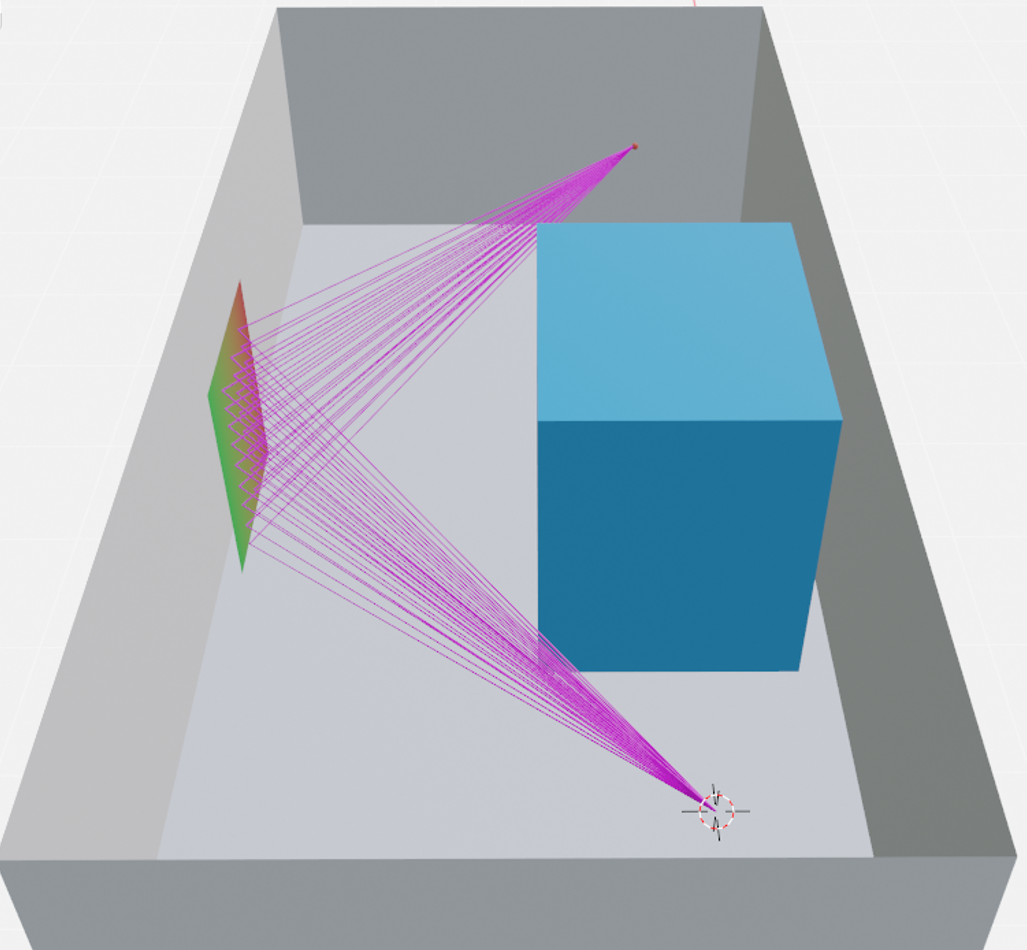
- Reconfigurable Intelligent Surfaces (RIS): Evaluation of RIS-assisted propagation, including comparisons of surface configurations, phase-shift profiles, beam steering, and potential coverage improvements in complex environments.
- Radar Simulations: Monostatic, bistatic, and multistatic radar simulation results, including target detection analysis, radar cross-section (RCS), scattering characteristics, and propagation effects for different transmitter–receiver configurations.
- MIMO to Massive MIMO: Evaluation of multiple-input multiple-output (MIMO) systems, from conventional MIMO to massive MIMO, including spatial channel characteristics, antenna-array configurations, beamforming strategies, and agreed system-level performance metrics.
Tailored Simulation Studies for Your Unique Challenges
The parameters, analyses, and outputs listed above illustrate just a sample of what’s possible with SIMaaS. We can combine multiple analyses into a customized study tailored to your research questions, engineering requirements, or application scenario.